
Ancient Pompeians and Modern University Students: On Graffiti, Bathrooms, and Online Forums
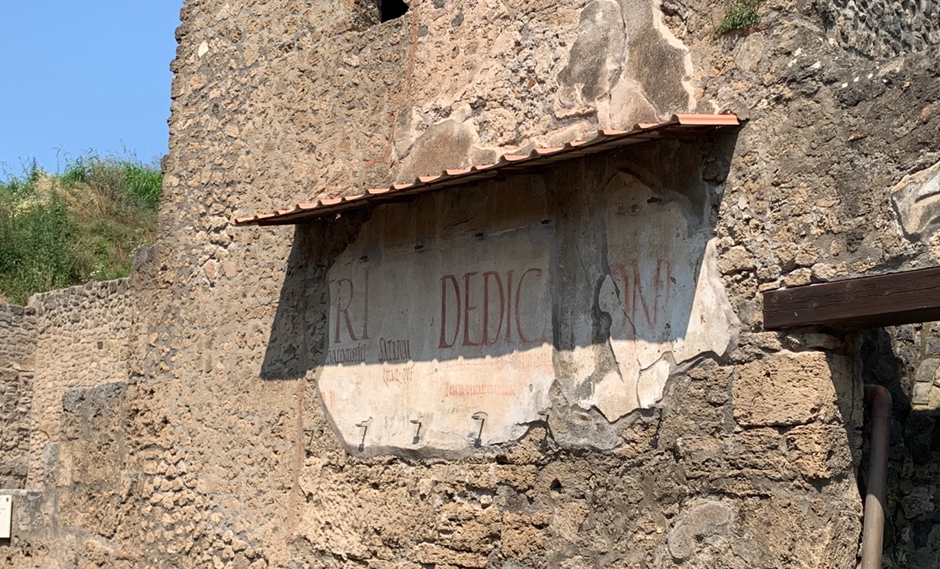
“Leaving one’s mark on a wall seems to reflect a desire as old as humankind.” (Lohmann 2020: 37)
Are ancient graffiti comparable to modern bathroom stalls? Are our concerns and topics similar to the ones of an ancient Pompeian? What would an ancient Pompeian write on a bathroom stall? These are some of the questions this blog post will try to answer.
If we want to understand the anxieties, thoughts, jokes, political affiliations of the people of Pompeii without them having to “save face” or use imposed structures and unnecessary politeness, we must look at graffiti. The slang used in graffiti “paints a picture that shows ourselves at our most human” (Green 2017: 3), holding an important place in the understanding of the true nature of ancient Pompeians.
This post will mostly focus on female perspectives since the bathrooms I was able to enter were women’s. However, if we compare them to the men’s, the latter often lack messages and rather focus on signs. There seems to be an abundance of symbols, sharing political affiliations, religious feelings, insults. In women’s bathrooms, by contrast, I found questions, advice, and compliments. For this reason, the latter are more appropriate to use in comparison with the graffiti found in Pompeii, as they share many more similarities in the nature of the comments, the vulgarity, and the feelings shared.
One of the possible reasons why we might lack more ancient graffiti from women may be the fact that a very small number of women in Pompeii was able to write (Harris 1983: 108), even though it is difficult to prove female authorship and readership (Milnor 2014: 200). Indeed, the women’s bathroom dismantles the typical stereotype that “slang remains overtly male” (Green 2017: 136).
It might seem surprising that ancient graffiti found in Pompeii share a similar tone of vulgarity with messages covering the bathroom stalls of a women’s toilet. There are not as many sexual comments which dehumanize a societal group (Pompeian graffiti often objectify women), but there are some examples of lack of decency and decorum. For instance, a comment in one of the stalls invited the users to “Rate ur pee / poo”, which prompted answers from other people who gave ratings out of 10 and provided some descriptive comments. This example is similar in nature to the graffiti found in the House of the Centenary in a latrine: “Secundus defecated here” written three times on the wall. (IX.8.3; CIL IV 3146).
In the modern world, these “public diaries” take a further step appearing in a digital space as well. For example, we can find anonymous messages in platforms where you can share love confessions, political thoughts, and questions. Trinity itself has multiple unofficial ones created by students, often called similarly to famous romance apps, such as Tringe (Trinity Hinge) or Trinder (Trinity Tinder). These pages allow you the same type of anonymity found in graffiti and latrinalia (toilet graffiti), but they also offer the idea that this is a student space where you can share almost anything.
If we analyse the core of graffiti and bathroom stall messages, we find similar meaning and significance in these two means of communication. They both present personal anxieties, political thoughts, support, boasting, advice, communication, desire to be there forever, even anonymously. As mentioned, the so-called “epigraphic habit of the communities of the Roman world” (Kruschwitz 2016: 26) shares fundamental similarities with messages found in bathroom stalls and the social media of the 21st century, as well as differences. Both mediums offer the possibility of answers being given to the original message, anonymity, and the desire and necessity to form a community through it. Indeed, Milnor insists on the importance of the archaeological and anthropological nature of graffiti: “Graffiti are meaningful not just as texts qua texts but as traces of the act of inscribing them” (Milnor 2011: 293).
In ancient Pompeii, written responses to graffiti were quite common, sometimes even creating a back-and-forth between the original messenger and the responders. A well-known example of a comment and an answer from the House of the Lovers reads:
“Lovers, like bees, lead a honeyed life”.
And the answer:
“I wish”.
(CIL IV 8408 from I.10.11; trans. Cooley and Cooley 2014: 111)
It is remarkable how similar both the nature and the structure of graffiti, bathroom stalls, and online forums seem to be between people that lived thousands of years ago and university students of modern times. This comparison does not only suggest the continuity of the human mind, it also leads to a further question. What would an ancient Pompeian write on university bathroom stalls and submit to online platforms? My imaginative contribution only hopes to build the bridge with people from the past.
So, here are some examples of what an ancient Pompeian might say if they were to write on a bathroom stall.
Example 1:
“GIRLS, did anyone hear that earthquake the other day?? IDK what it was but I’m shook. Hope nothing else happens #Pompeiiforthewin #Ihopethewallsdonttumbledown #inthecitythatwelove”
This is a message that I believe could be written on a wall in the women’s toilet. It uses random capitalised words, which is very common for our generation. It also uses abbreviations such as “IDK”, which stands for “I don’t know”. Lastly, it has become very common for my peers to use hashtags in an ironic way. In the last hashtag, we can find a song lyric from the song “Pompeii” which is very popular and is a reference that anyone in that bathroom would understand.[1]
Example 2:
Person 1: “Girls, my hubby doesn’t want me to go to Lavinia’s party tomorrow :( IDK what to do… he says he’s gonna embarrass me and go to the brothel in the middle of the day and tell every one of our friends that he’s got a missus. HELP!!!
Person 2: “I say leave him and go be a girlboss”
Person 3: “don’t let no man bring a QUEEN down!”
Person 4: “Aww DW* there will be other parties. I wouldn’t risk it”
Person 5: “Come stay with me for a couple nights, he can go to hell”
Person 1: “Thanx girls, IDK I’m just afraid BC* IDK what he might do and I don’t have any money or any family to go to since we moved to Pompeii, away from them”
Person 6: “You can call this number if he is abusing you”
Further abbreviations: DW = don’t worry; BC = because.
In this last thread, the first person is sharing a problem and personal anxiety that she is facing because of her husband. The answers from the other people show both support, advice as well as contrasting views. The last message, however, introduces a difference that we do not find in ancient graffiti, and that is the presence of stickers, fliers and messages with helplines that can give you the right support if you are being abused, or if you are having any mental difficulty. Fortunately, these can be found both in toilets and online.
As explored by this blog post, ancient graffiti from Pompeii, bathroom stalls and their digital form all share exceptional similarities. Through these, we can understand the personal challenges that people face, as well as social, political and comedic situations. Needless to say that if ancient Pompeiians were to find themselves in a university bathroom or an online forum, they would not find either space too difficult to navigate.
Bibliography:
Primary: CIL IV 3146, 8408
Secondary:
Cooley, A. E. and Cooley, M. G. L. (eds) 2014. Pompeii and Herculaneum: A Sourcebook, 2nd edition. London: Routledge,.
Green J. 2017. The stories of Slang: Language at its most Human. London: Robinson.
Harris, W. V. 1983. “Literacy and Epigraphy, I.” Zeitschrift Für Papyrologie Und Epigraphik 52: 87–111.
Kruschwitz, P. 2016. “Inhabiting a lettered world: Exploring the Fringes of Roman Writing Habits” Bulletin of the Institute of Classical Studies 59: 26-41.
Lohmann P. 2020. “Historical Graffiti: The State of the Art” Journal of Early Modern Studies, 9: 37-57.
Milnor K. 2011. “Literary Literacy in Roman Pompeii: The Case of Vergil’s Aeneid” in W. A. Johnson and H. N. Parker (eds), Ancient Literacies: The Culture of Reading in Greece and Rome. New York: Oxford University Press, pp. 288–319.
Milnor K. 2014. Graffiti and the Literary Landscape in Roman Pompeii. Oxford: Oxford University Press.
Digital links:
[1] Song “Pompeii” by Bastille https://youtu.be/F90Cw4l-8NY?si=3zs4UPFMjBxyVsm1
Anna Volpe (she/her) is an alumna of TCD Classics, graduating in 2026. Her undergraduate thesis focused on traces of bilingualism of Demotic and Greek in Ancient Roman Egypt. Her academic interests lie in ancient languages, with a particular attention towards undeciphered languages. The inspiration for this piece stemmed from a university project for a class on Social Media in the Ancient Roman World, where she noticed that the concept of ancient Pompeian graffiti is not as remote as we might think.
Photo credit: Pompeii, Anna Volpe.