
Gellius and his predecessor, Borges
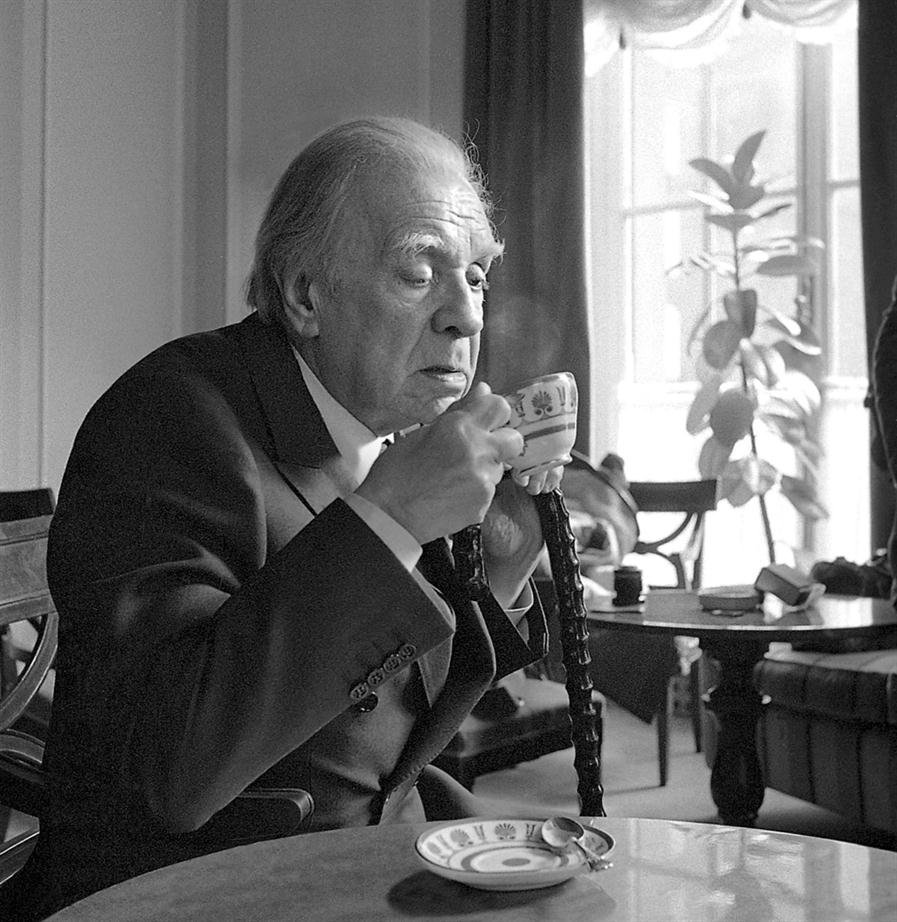
El propio Jorge Luis Borges, tal y como lo pude ser Aulo Gelio, es un vehículo no sólo para la lectura de sus propios textos, sino para la invitación a la lectura de autores acaso recónditos… (García Jurado 2000: 183) [1].
Jorge Luis Borges himself, just as Aulus Gellius could be, is a vehicle not only for the reading of his own texts, but also for the invitation to read authors perhaps recondite… (my translation).
Borges wrote an essay titled ‘Sobre los clásicos’ [1952] in which he defines what is, in his view, a classic book. Of course, he is not specifically referring to (our) Classics but to classics in a broader sense. Borges starts off his essay by examining the etymology of some words, and as Francisco García Jurado (2021: 246-248) notes, he mentions the etymology of persona, ‘mask’. This etymology can be found in Aulus Gellius’ Noctes Atticae (Attic Nights), chapter 5.7. The Noctes Atticae (henceforth, NA) by Aulus Gellius, a 2nd-century CE Roman writer, is a unique source of information about Greco-Roman literature, culture and both elite and common language. Written at a time when texts from the Republican period (3rd-1st century BCE) were still available, the NA is invaluable for its preservation of both fragmentary and 'canonical’ literature. We possess no information about Gellius beyond what can be found in the so‑called ‘autobiographical’ chapters, which inevitably raise the question of whether their content should be read as factual accounts, as verisimilar constructions, or as deliberately literary fabrications.
Going back to Gell. 5.7, Gellius quotes a (now) lost work, de origine uocabulorum by a (now) almost unknown Latin Republican scholar, Gavius Bassus. In fact, if one wants to have any information regarding Gavius Bassus and consults the Oxford Classical Dictionary (by the way, consulting encyclopaedias and quoting unknown authors is a very Borgesian device; a case in point is Borges’ longer short-story, ‘Tlön, Uqbar, Orbis Tertius’ [1941], the plot of which is derived from an imaginary and fictional encyclopaedia), the only information we find is the following:
Gavius (RE 11) Bassus, late republican scholar whose (lost) works on etymology (De origine vocabulorum) and religious antiquities (De dis) are quoted by Quintilian, A. Gellius, and Macrobius. (OCD 4ed., s.v. Gavius Bassus [Kaster]).
Another famous Argentinian writer, Julio Cortázar, devotes chapter 148 of his experimental novel Rayuela to this etymology, and directly quotes Gellius 5.7. [2]
Throughout Borges’ work we can find a myriad of classical references and it could be said that his relation to Classics is almost infinite and unlimited, forming a sort of sphere, whose centre is everywhere and whose circumference is nowhere.[3] For instance, I recall (to borrow a Borgesian word, see ‘Funes, His Memory’ [1944]) that in ‘The Immortal’ [1949], whose main character is Homer, the narrator declares that he used Pliny’s Naturalis Historia to elaborate parts of his narration. In ‘The Aleph’ [1949] we find explicit references to Odyssey 1.3 (Borges 1999a: 276 ‘I have seen, as did the Greek, man's cities and his fame’, which is a play on πολλῶν δ' ἀνθρώπων ἴδεν ἄστεα καὶ νόον ἔγνω: ‘He saw the cities and knew the minds of many men’ Huddleston transl.), as well as to Hesiod’s Works and Days and to the Georgics, which the narrator mockingly compares with a ‘farming themed’ Argentine novel, Don Segundo Sombra. On another note, Borges declares in his prologue to ‘The Maker’ [1960] that the finest transferred epithet (namely, the hypallage) was used by Virgil (Verg. Aen. 6.268 ibant obscuri sola sub nocte per umbram: ‘On they went dimly, beneath the lonely night amid the gloom’ Loeb transl.), who uses and surpasses this rhetorical figure. I am even tempted to say that in every transferred epithet that we find in Borges, he is quoting Virgil.
Borges’ exemplar(s) of the Noctes Atticae
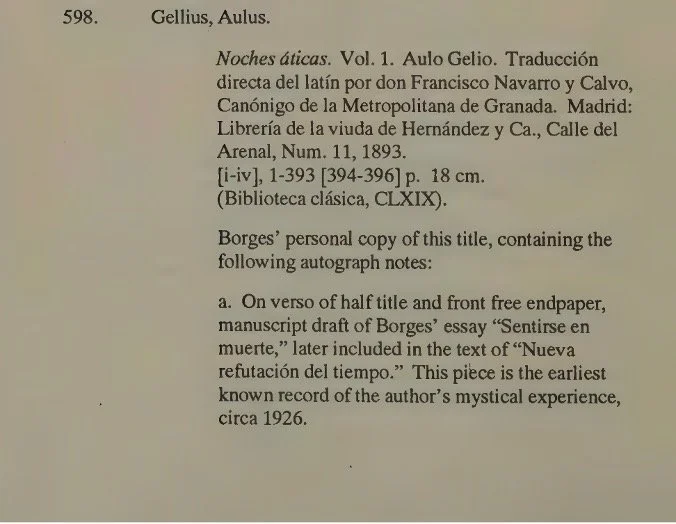
Left to right: Fig 1: from A Descriptive Catalogue of the Jorge Luis Borges Collection at the University of Virginia Library (1993: 144);
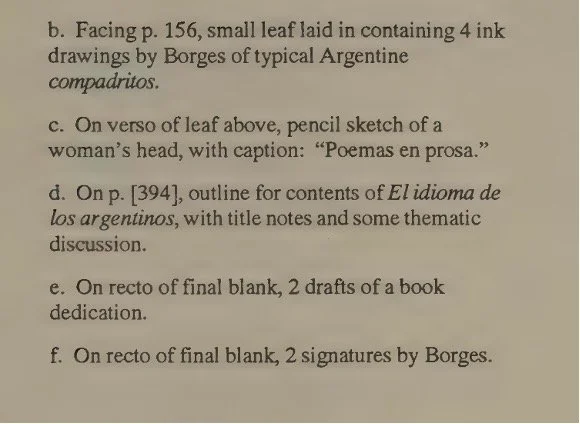
Fig. 2: from A Descriptive Catalogue of the Jorge Luis Borges Collection at the University of Virginia Library (1993: 145).
Regarding the NA, Borges owned a copy of it in the Spanish translation by Francisco Navarro y Calvo in two volumes (1893). According to the A Descriptive Catalogue of the Jorge Luis Borges Collection at the University of Virginia Library (1993: 144) Borges had the first volume of Navarro y Calvo’s translation (books 1-10); I am not sure where the second volume is held. In fact, if we pay attention to Borges’ explicit references to Gellius, both of them belong to the first volume of Navarro y Calvo’s translation: Gell. 5.10 and 10.12. Does this mean that Borges knew only the first 10 books of the NA, i.e. those of the first volume? It would be interesting to explore other catalogues in order to establish with certainty if he owned the second volume too. Nevertheless, Adolfo Bioy Casares, Borges’ friend and renowned Argentinian writer (who wrote, among other books, La invención de Morel, a book that in part ‘inspired’ the TV series Lost [2004-2010] and that appears in an episode), makes an explicit reference to both volumes:
Mi afecto por las Noches Áticas de Aulo Gelio, dos tomitos de la vieja Biblioteca Clásica, abarca el formato y la encuadernación en pasta española (1991: 79) [4]
My affection for Aulus Gellius’ Attic Nights, two little volumes from the old Biblioteca Clásica, extends to the format and the Spanish‑style binding (my translation).
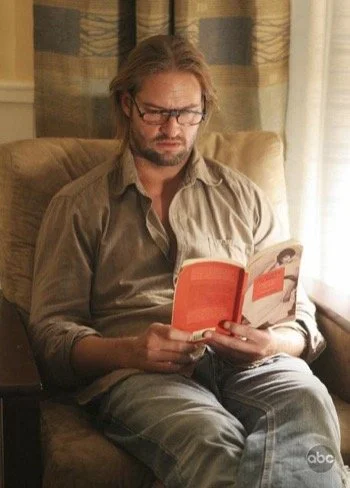
Fig. 3: Sawyer is reading La invención de Morel. In ‘Eggtown.’ Lost, Season 4, Episode 4.
[writers Elizabeth Sarnoff and Greggory Nations, dir. Stephen Williams, executive prods. J.J. Abrams, Damon Lindelof, Carlton Cuse, Jack Bender, and Bryan Burk, Bad Robot Productions, 21 Feb. 2008, ABC].
What we do know for certain is that Borges used the last blank pages of this exemplar as a support for a sketch, later published under the name of ‘Sentirse en muerte’. It is worth noting that the text of the NA that Borges had at hand was only a Spanish translation. However, this was not always the case. Regarding Pliny in ‘Funes, His Memory’ [1944], a short story dedicated to the prodigious and infinite memory of Ireneo Funes, we find that he read Pliny in the original Latin version with the aid of a dictionary and he even quotes a phrase in Latin: ut nihil non iisdem uerbis redderetur auditum (in Borges 1998: 134; Plin. nat. 7, 88 ‘enabling anything heard to be repeated in the identical words’).
Structural affinities between Borges oeuvre and the Noctes Atticae
Arbitrary as the instances I have recalled here may be, the fact is that the NA and Borges’ work share in-depth, structural affinities. Francisco García Jurado (2021: 234) thinks that even though Gellius is not the Classical author most quoted by Borges, the Roman writer is perhaps the one who most inspired the miscellaneous disposition of Borges’ writings. García Jurado (2021: 251), in fact, compares Gellius’ praefatio and Borges’ epilogue to The Maker [1960] and notes that there are some interesting parallels between both of them, such as time, disposition of the material and lack of order. Let us take a look at both texts:
Gell. praef. 2-3 2 Vsi autem sumus ordine rerum fortuito quem antea in excerpendo feceramus. Nam proinde ut librum quemque in manus ceperam seu Graecum seu Latinum, uel quid memoratu dignum audieram, ita quae libitum erat, cuius generis cumque erant, indistincte atque promisce annotabam, eaque mihi ad subsidium memoriae quasi quoddam litterarum penus recondebam, ut quando usus uenisset aut rei aut uerbi cuius me repens forte obliuio tenuisset, et libri ex quibus ea sumpseram non adessent, facile inde nobis inuentu atque depromptu foret.
But in the arrangement of my material I have adopted the same haphazard order that I had previously followed in collecting it. For whenever I had taken in hand any Greek or Latin book, or had heard anything worth remembering, I used to jot down whatever took my fancy, of any and every kind, without any definite plan or order; and such notes I would lay away as an aid to my memory, like a kind of literary storehouse, so that when the need arose of a word or a subject which I chanced for the moment to have forgotten, and the books from which I had taken it were not at hand, I could readily find and produce it. (Transl. Rolfe)
God willing, the intrinsic sameness of this miscellany –which has been compiled not by me but by time and includes early pieces that I have not dared tinker with, since they came out of a different view of writing– will prove less obvious than the historical and geographical range of its themes. Of all my published books, none I believe is so personal as this ragtag, random assortment, for the very reason that it is rich in reflection and in literary interpolation. Little has taken place in my life, but I have read a great deal. Or, rather, little has taken place more worthy of memory than Schopenhauer’s thinking or the word music of England (Borges, ‘Afterword’, in The Maker, 63)
What I want to propose however is a personal reading, according to which in the NA we can find some ‘Borgesian’ elements ante litteram. I am of course playing on one of Borges’ most famous short-stories, ‘Kafka and his Precursors’ [1951], in which Borges proposes a radical reading of Kafka: some texts that were written way before Kafka retroactively reveal their Kafkian (not Kafkaesque!) matrix. For instance, Borges writes that Zeno’s paradox against movement, as we can read it in Aristotle, prefigures the form of Kafka’s The Castle, whereas ‘the moving body and Achilles and the arrow are the first Kafkian characters in literature’ (1964: 106). Kafka, a precursor of Zeno!—the idea is staggering. [5]
While the touchpoints are numerous, I want to concentrate on what we can call a shared attitude towards culture in general and books in particular. Borges is famous for his devotion to books. For example, in ‘Partial Enchantments of the Quixote’ (1964: 46) Borges writes: ‘In 1833 Carlyle observed that universal history is an infinite sacred book that all men write and read and try to understand, and in which they too are written.’ Moreover, Borges wrote an essay titled ‘On the cult of Books’ [1951] and, his poem ‘The Moon’ [1960], the Argentine writer confesses that he can better remember the moons he had read (he had found in books) than the actual moon:
Más que las lunas de las noches puedo
recordar las del verso: la hechizada
dragon moon que da horror a la balada
y la luna sangrienta de Quevedo.
More than moons of the night, there come to mind
moons I have found in verse: the weirdly haunting
dragon moon that chills us in the ballad
and Quevedo’s blood-stained moon, fully as daunting (1999b: 109)
The same devotion for books can be found in Gellius, who, in an ‘autobiographical’ chapter tells the reader that when he was appointed judge—up to that moment he was immersed in poetry and rhetorics—he consulted books written in Latin and in Greek; indeed, books are defined by Gellius as muti magistri:
Gell. 14.2.1 Quo primum tempore a praetoribus lectus in iudices sum, ut iudicia quae appellantur priuata susciperem, libros utriusque linguae de officio iudicis scriptos conquisiui, ut homo adulescens a poetarum fabulis et a rhetorum epilogis ad iudicandas lites uocatus rem iudiciariam, quoniam uocis ut dicitur uiuae paenuria erat, ex mutis quod aiunt magistris cognoscerem.
At the time when I was first chosen by the praetors to be one of the judges in charge of the suits which are called ‘private,’ I hunted up books written in both languages on the duty of a judge, in order that, being a young man, called from poets’ tales and orators’ perorations to preside in court, I might from lack of the ‘living voice,’ as they say, gain legal lore from so-called ‘mute counsellors.’ (Trans. Rolfe)
Moreover, as seen above in the preface, Gellius defines his work as a ‘literary storehouse’, a sort of Noah’s Ark containing books, while, in ‘The Library of Babel’ (1998: 112), Borges imagines an unlimited and periodic library, formed by an indefinite number of hexagonal libraries:
The universe (which others call the Library) is composed of an indefinite, perhaps infinite number of hexagonal galleries. In the center of each gallery is a ventilation shaft, bounded by a low railing. From any hexagon one can see the floors above and below-one after another, endlessly. The arrangement of the galleries is always the same: Twenty bookshelves, five to each side, line four of the hexagon's six sides; the height of the bookshelves, floor to ceiling, is hardly greater than the height of a normal librarian. One of the hexagon's free sides opens onto a narrow sort of vestibule, which in turn opens onto another gallery, identical to the first-identical in fact to all.
This is the description a world made of books or, in other words, of the universe as a Library. The reflection that closes ‘The Library of Babel’ concerns an eternal traveller crossing the library in any direction, who would find sooner or later that ‘the same volumes are repeated in the same disorder—which, repeated, becomes order: the Order.’
I find in the idea of the existence of an underlying pattern in a disordered set a possible reflection on Gellius’ preface. The question of the order-disorder of the whole work as announced in the preface of the NA is indeed one of the most debated ones among Gellius’ scholars, and it is still an open question. In fact, since we do not possess book 8, all our accounts will be partial until –hopefully– we can find it. Nevertheless, perhaps the Borgesian eternal traveller (therefore, the eternal reader, as, in some sense, is Gellius too), sub specie aeternitatis, would be able to find the underlying Order that informs the NA, even if that Order is just Organised Disorder. The eternal reader invites us to read and re-read our texts. Perhaps, in re-reading Gellius, we may discover details that escaped notice in earlier readings. A Borgesian reading of Gellius allows us to make sense of this historically situated yet strikingly contemporary text.
On a closing note, I invite the reader to open Borges’ oeuvre or Gellius’ book at random, following no method or order, and simply let their curiosity guide them. By doing so, the reader may come to share my conviction that Gellius contains Borgesian elements ante litteram, and that we may therefore play with the idea that Borges is, in a sense, one of Gellius’ precursors.
Opening image credit: https://commons.wikimedia.org/wiki/File:Borges_drinking.jpg

Notes
[1] Francisco García Jurado is one of the most important scholars of the Noctes Atticae particularly regarding its reception. He is the author of a selective Spanish translation of the Noctes Atticae for Alianza Editorial (2009). I am greatly indebted to his work, especially for what concerns the reception of Aulus Gellius among twentieth‑century Argentine authors.
[2] In the canonical editions there is a typo in which ‘Aulo’—Aulus in Spanish—becomes ‘Aulio’.
[3] Borgesian reference to ‘Pascal’s sphere’ [1951].
[4] I owe my knowledge of this reference to García Jurado 2021: 238.
[5] I am doing a collage with ‘Pierre Menard, Author of the Quixote’ (1998: 94): ‘History, the mother of truth!—the idea is staggering’.
Further reading:
In 2024, a monograph titled Reading Miscellany in the Roman Empire was published by the renowned scholar Scott J. DiGiulio, which includes an interesting chapter devoted to the relationship between Gellius and Borges (2024: 289–293). DiGiulio focuses primarily on their shared approach to miscellany. In addition, Laura Jansen’s Borges’ Classics: Global Encounters with the Graeco-Roman Past (2018) offers a scholarly exploration of Borges’s engagement with classical antiquity, further enriching the dialogue between Borges and the ancient tradition. See also this interesting website, in which the scholar Jonathan Basile created a randomly organised library: https://libraryofbabel.info
Bibliography
Borges, Jorge Luis (1923), Obras Completas I (Buenos Aires: Emecé).
-- (1952), Obras Completas II (Buenos Aires: Emecé).
-- (1964), Other inquisitions, 1937-1952, trans. Ruth L. C. Simms (Austin: University of Texas Press).
-- (1975a), Obras Completas III (Buenos Aires: Emecé).
-- (1975b), Obras Completas IV (Buenos Aires: Emecé).
-- (1984), Seven Nights (New York: New Directions Publishing).
-- (1998), Collected Fictions, trans. A. Hurley (New York: Penguin).
-- (1999a), Selected Non-Fictions (New York: Penguin).
-- (1999b), Selected Poems (New York: Penguin).
-- (2002), This Craft of Verse: The Charles Eliot Norton Lectures 1967-1968 (Cambridge: Harvard University Press).
-- (2010a), Oeuvres complètes I (Paris: Gallimard).
-- (2010b), Oeuvres complètes II (Paris: Gallimard).
DiGiulio, Scott J. (2024), Reading Miscellany in the Roman Empire. Aulus Gellius and the Imperial Prose Collection, ed. (Oxford University Press/(New York).
Jansen, L. (2018). Borges' Classics: Global Encounters with the Graeco-Roman Past. (Cambridge: Cambridge University Press).
Jurado, Francisco García (2007), 'Símiles y metáforas de la erudición en Aulo Gelio', Emerita, 75 (2), 279-98.
-- (2009), 'La peculiar fortuna de Aulo Gelio en la moderna literatura argentina', Argos, 32, 45-63.
-- (2011), 'Qué entiende Aulo Gelio por «Literatura griega» y «Literatura latina»', in J.B. Torres (ed.), VTROQVE SERMONE NOSTRO. Bilingüismo social y literario en el Imperio de Roma (Pamplona: EUNSA), 69-82.
-- (2012a), 'Aulo Gelio y la literatura española del Siglo XVI: autor, texto, comentario y relectura moderna', Revista de literatura, 74, 31-64.
-- (2012b), ''Mentir' y 'Decir mentira'. Una differentia entre la miscelanea de Aulo Gelio y el ensayo de Montaigne', Atene e Roma, 6 (1-2), 1-20.
-- (2014), 'Borges, Aulo Gelio y la memoria: el ‘almacén literario’', Reinventar la Antigüedad.
-- (2015), 'Dos intertextos latinos en Cortázar: Plinio el Joven y Aulo Gelio. La casa profunda y la miscelánea', Comparatismes en Sorbonne, 6.
-- (2021), 'La memoria y la noche. Borges y Aulo Gelio: entre la antigua miscelánea y el moderno ensayo hispanoamericano', Revista de Crítica Literaria Latinoamericana, 93, 233-55.
-- (2025), 'El encuentro complejo entre Rayuela y las Noches áticas: “del lado de allá” y “del lado de acá”', Nova Tellus, 43 (2), 181-206.
Loewenstein, C.J. (1993), A Descriptive Catalogue of the Jorge Luis Borges Collection at the University of Virginia Library (University Press of Virginia)
Facundo Peirano Corrigedor is a Ph.D. candidate in the Department of Classics, Trinity College Dublin. He is funded by a Taighde Éireann/Research Ireland postgraduate scholarship. His research project focuses on Books 14–20 of Aulus Gellius’ Noctes Atticae. This antiquarian miscellany preserves a remarkable range of material, including fragments of early Latin literature that would otherwise be lost.