
Sabrina Carpenter: A Female Catullus?
Ten years on from the beginning of my university studies, I still fondly remember my time in the Classics Department. One of my favourite aspects of classical literature was Roman poetry, particularly the love poetry of Catullus. Notions of gender, masculinity and femininity are constantly in flux, and it is interesting to see how gender relations have changed over time. To that end, this blog post will compare and contrast the poetry of Catullus with modern pop singer Sabrina Carpenter and will argue that both employ similar strategies to deal with difficulties in love.
In his poems, love is an energising and an agonising force for Catullus. As he expresses pithily ‘I hate and I love. Perhaps you’re asking why I do this. I don’t know but I feel it happening and I am racked.’ (Cat. 85) His relationship with his beloved Lesbia swings from affection, demanding a thousand kisses, to bitter hatred. In his poetry we see Catullus negotiating masculinity and attempting to stay within the bounds of Roman masculinity - rational and in control - while also engaging in passion with his lady love.
The Roman virtues of self-restraint and rationality represent a hegemonic masculinity in the world of the poems. In times of stress, Catullus falls back on his masculinity and he also uses it as a tool of invective against his fellow men. For example, in poem 6, he makes fun of Flavius for being lovesick. Flavius’ bedroom is reeking of flowers and Syrian perfumes and the pillow has been dented (Cat. 6). Similarly, Catullus uses aggressive sexual language as a threat against those he dislikes. We see, for instance, in poem 16 that he threatens some acquaintances for accusing him of being sissy. Again, when threatened, the Roman man retreats inside his own masculinity (Cat. 16).
Yet when Catullus is secure in his love and in his relationship with Lesbia, such concerns fall away. He famously discards the opinions of the old men (Cat. 5). He expresses his sensitive side in feminine terms. When he berates Lesbia for sleeping with 300 people, the image he uses - that of a flower being destroyed by a plough - is of a masculine force pulverising a feminine one (Cat. 11).
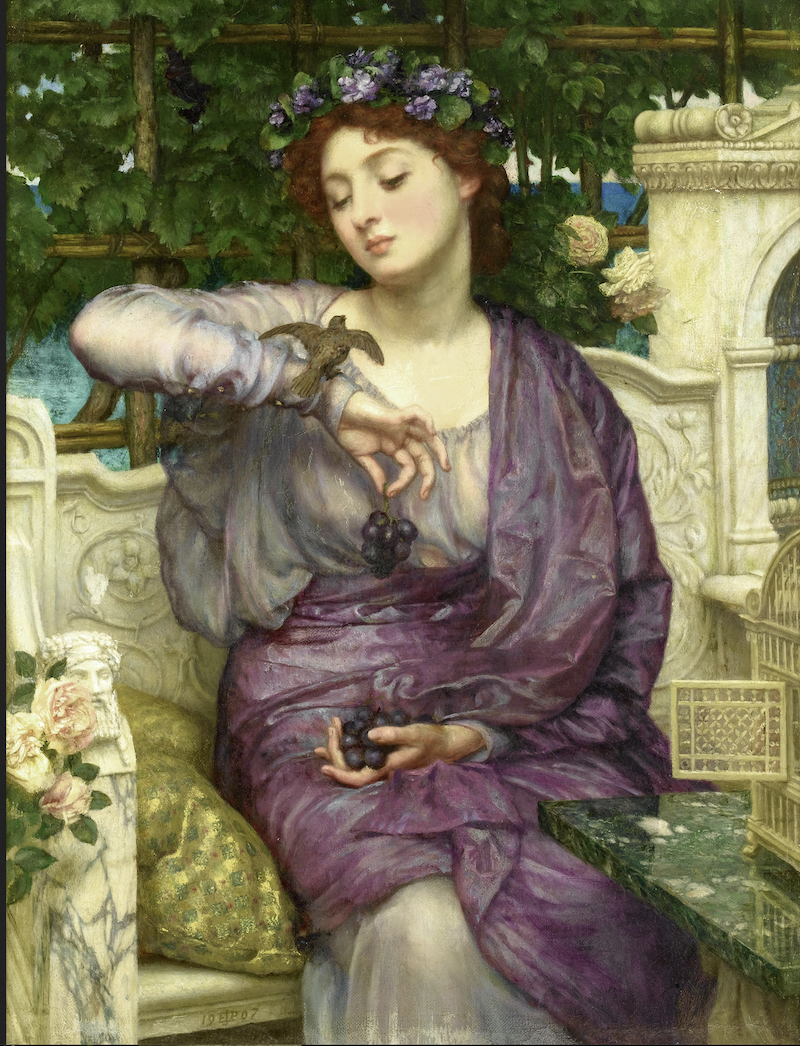
We get very little insight into Lesbia herself and the poet rarely grants access to her perspective. Most conspicuous is poem 3, where the poet describes Lesbia’s tears on the death of her beloved sparrow. On the whole we only get the poet’s description of her feelings or his invective against her.
Busy Woman
This dynamic seems to be reversed in Sabrina Carpenter. Here, we get access to the woman’s perspective and scant access to the man’s. At first glance, Carpenter seems to enjoy a position of power. She depicts herself in control of her feminine charms and bored with the mutt-like behaviour of her lovers. In the chorus of ‘Manchild’ (Carpenter 2025) she bemoans:
‘Never heard of self-care
Half your brain just ain’t there
Manchild
Why you always come running
Taking all my lovin’ from me.’
Yet, at the same she seems to enjoy this: ‘I like my boys playing hard to get/and I like my men all incompetent.’ This sets up a duality that runs throughout the entirety of Carpenter’s discography. If Catullus can be said to retreat into his own masculinity when wounded, then Sabrina Carpenter retreats into a hyper sexual femininity.
For instance, the song ‘My Man On Willpower’ almost acts as a parody and inversion of Lesbia and Catullus. The song opens with the speaker lamenting that her man was ‘clinging and lovin’, calling and touching’ but now he’s a stranger having developed ‘willpower’. The speaker is at a loss and, having tried everything - including her ‘slutty pyjamas’ to win her man back - concludes that her man is no more. Here, Carpenter presents herself as man-obsessed, eager for power and dismissive of her man’s desire for growth. Interestingly, his self-control is seen as a temporary fad or as an annoyance instead of a property to be admired, as it was in ancient Rome. We could almost imagine the song as something that Lesbia could have written when Catullus was in one of his masculine moods.
Sabrina continues to lean into this armour throughout the album. Similarly to Catullus with his peers, she uses the sexual as a form of invective. In ‘Never Getting Laid’ she ends a curse to her lover with the wish of ‘a lifetime full of happiness and a forever of never getting laid.’ Elsewhere, in the song ‘Taste’ she consoles herself that while her lover is now with another woman, she’ll have to ‘taste’ Carpenter. ‘Every time you close your eyes/and feel his lips you’re feeling mine/and every time you breathe his air, just know I was already there.’ (Carpenter 2024)
If this then is Sabrina in attack mode, then where can we find the sensitive Sabrina? The answer lies in the song ‘Nobody’s Son’ which does shed light on her vulnerability. The song opens with Carpenter receiving a text from her ex saying that they should take a break, so he can ‘grow emotionally’ which echoes ‘My Man on Willpower’.
She then laments, in an image as pitiful as Lesbia weeping over her sparrow:
‘Here we go again
Crying in bed
What a familiar feeling
All my friends in love
And I’m the one they call for a third wheelin’
Probably should have guessed
He’s like the rest
So fun and so deceivin’
There’s nobody son left for me to believe in.’
Despite a later attempt to retreat into her femininity by mocking the man for ‘discovering self-control’, her hurt is clear as evidenced by the above refrain in the chorus of the song. The tension between the two Sabrina’s reaches a pitch in the bridge:
‘That boy is corrupt
Could you raise him to love me maybe
He sure f**** me up.
And yes, I’m talking bout your baby.
That boy is corrupt
Get PTSD on the daily.’
Interestingly, the lyrics here are undercut by the sound of whips. The implication is clear: Sabrina is trying to maintain control of her domineering ultra sexual persona even when she’s detailing how her lover has deeply hurt her This is similar to how Catullus casts himself in the role of as a daring masculine soldier travelling to far off locales such as India or Hyrcania in order to inoculate himself against the hurt caused by Lesbia and her multiple lovers. (Cat. 11)
What is most striking is how, even though they are separated by 2000 years, both Catullus and Carpenter employ the same mechanisms in navigating their own heartache by leaning into their respective gender roles. Carpenter is no mere update on Lesbia: to cite her increased agency and control when set against her ancient Roman counterpart would be a truism. Rather, she is a new feminine Catullus who picks up on his age-old agonies and breathes fresh life into his poetry. Her lyrics and the questions they bring up are a reminder of the relevance of Roman poetry, a symbol of how humans across time and space have dealt with the pain of love.
References
Catullus, The Complete Poems (trans: Guy Lee). Oxford: OUP.
Carpenter, S. (2025) Man’s Best Friend. Island Records
Carpenter, S. (2024) Short n Sweet. Island Records.
See the link below for a playlist of the songs discussed in this post.
https://youtube.com/playlist?list=PLcGdT_OStmak&si=fEGcs129GGz0H8ZM
Ross Coleman is a graduate of the Department of Classics (2020) and is a freelance writer and journalist.
He is about to commence his PhD in Scoil na Gaeilge, DCU examining conceptions of masculinity and femininity in the work of Irish language author Pádraic Breathnach.